

How Growers Are Reducing Costs and Increasing Efficiency to Gain an Advantage
Combined Heat and Power (CHP) Systems are becoming increasingly popular in agricultural settings. The savings and efficiencies recognized from generating power on site and capturing the heat produced are substantial. Financially, those who can grow plants fast with high yields and low operational costs will gain an advantage. CHP is helping greenhouse growers do just that.

CHP for Cannabis Growers
For cannabis producers, while the competitive landscape is expanding, it will eventually plateau. Those who prevail will be businesses with the foresight to streamline costs and address the basic need for power resiliency. Relying on traditional power delivery could negatively impact profitability if an unexpected power interruption results in the loss of plants, mothers, and goods-in-process.
Benefits of CHP
Traditionally, the delivery of heat and power are through separate processes. However, those separate processes can lead to wasted energy and high utility costs. Generating electricity at a distant power plant causes the release of a large amount of energy into the environment; also known as “waste heat.” Fortunately, CHP systems generate energy more efficiently. The CHP process produces power, heat and carbon dioxide, all needed to maintain a healthy greenhouse environment.
CHP benefits growers by:
- Protecting the facility from an unexpected power loss
- Creating heating, cooling and dehumidification
- Utilizing CO2 produced to accelerate plant growth
- Increasing overall plant yield
- Reducing the carbon footprint of the growing facility
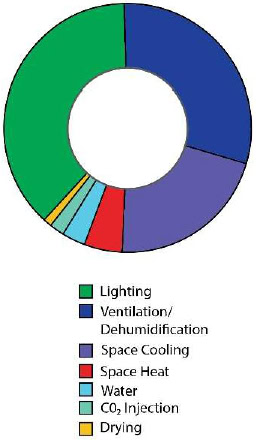
Power is generated onsite to supply facility electrical loads such as lighting and ventilation. Heat produced from the engine is captured and delivered to the facility as a hot water loop that can store the energy and deliver it to the facility as needed for air conditioning and humidity control. Counterintuitive as it may sound, the hot water can directly produce chilled water through an absorption chiller. The chilled water is used for cooling and dehumidification. Some hot water may be needed to reheat the air after moisture has been condensed out.
Free carbon dioxide created in the combustion process is cleaned to appropriate levels for growing environments, then redirected into the facility. This process enables plants to benefit from the introduction of additional carbon dioxide, typically supplied to growing facilities from expensive compressed or liquefied CO2 tanks. The higher concentration of CO2 accelerates plant growth, improving productivity.
Choosing a CHP Partner
When considering a CHP system, it is necessary to fully examine the facility’s energy needs, existing and planned infrastructure, and state/local regulations and incentives. A partner that is familiar with CHP development, commissioning, installation, and service is essential. Working with a company that supplies the highest-quality CHP equipment coupled with experience providing informed project-guidance offers an advantage.
Why Kinsley Energy Systems?

Kinsley Energy Systems is a value-added provider of equipment and service for the highest-quality distributed energy systems from 6kW to 16+MW. We work in partnership with dependable developers, engineers, and contractors. We are guided first and foremost by our customers’ needs and collaborate openly to develop solutions that generate the best possible return on investment.
Kinsley Energy Systems actively collaborates with our customers to ensure the right CHP specification for each project. As a distributor of high-performance products made by top equipment manufacturers, adding value to the supply chain is our key differentiator. Kinsley engineers provide valuable assistance in assessing the feasibility of a project, sizing equipment, optimizing the use of the available thermal energy, and calculating the total lifecycle cost and return on the project. Kinsley’s factory-trained service technicians provide commissioning support, emergency service, and preventative maintenance. In business for over 55 years, Kinsley focuses on forming partnerships for the life of every power plant we deliver.
- Packaged Reciprocating Engine CHP: 100 – 4,000 kW
- Radial Gas Turbines: 1.8 MW
- Axial Gas Turbines: 10.5 – 13.9 MW
As growers look to cut costs and boost yields, improving power resiliency and energy efficiencies through CHP is becoming essential. Begin a discussion today to learn more about CHP for commercial greenhouse growers. Contact Kinsley Energy Systems at 800-255-3503 or kmccord@kinsleyenergy.com.